![[Alt de la portada]](kill-bill-70mm-super-35-truth-myth/portada.jpg)
When 35mm Ruled the Earth
I remember perfectly what 35mm prints were like in 2003: they were heavy. When the distributor of Kill Bill: Vol. 1 sent the cans to projection booths all over Spain, after assembling them, the projectionists' fingers weren’t stained with emulsion; they were covered in Tarantino-grade blood.
The film, like almost all cinema of the time, came with simultaneous sound systems printed on the same roll of film:
• Dolby Digital 5.1, printed between the perforations.
• SDDS on the outer left edge of the film (not all booths could read it).
• Analog Dolby Surround SR next to the image frame.
• DTS between the image frame and the SR track (a timecode synced with an external audio CD).
However, the original negative of Kill Bill was silent. Quentin Tarantino and his director of photography, Robert Richardson, had shot the film in Super 35mm. This format uses the same physical film stock as any 35mm, but uses the full width of the negative, including the space that exhibition prints reserve for the optical sound track. The resulting frame is larger and offers greater framing flexibility, but it also makes the film grain more visible.
Once shooting wrapped, that Super 35 negative was digitally scanned at the Technique laboratory in Burbank for color grading, adding visual effects, and reframing the image. From this process, a new master was generated from which the 35mm exhibition prints would be struck, now with space for the sound tracks. This workflow is known as Digital Intermediate (DI), and in 2003 it was cutting-edge technology. The standard resolution was 2K, sufficient to print photochemical copies with cinematic quality.
"You're therefore seeing more of the grain structure, so you have to present the very best, most pristine negative possible to the Super 35 process." — Russell Carpenter ASC, American Cinematographer, December 1997.
The DI, the very tool that allowed for intervening and controlling the grain of Super 35, also introduced a digital layer that redefined its original texture. The result was an image that was no longer exactly what came off the negative, but a filtered, tuned, and ultimately restrained version. The DI saved Super 35 but, in part, it also sterilized it.
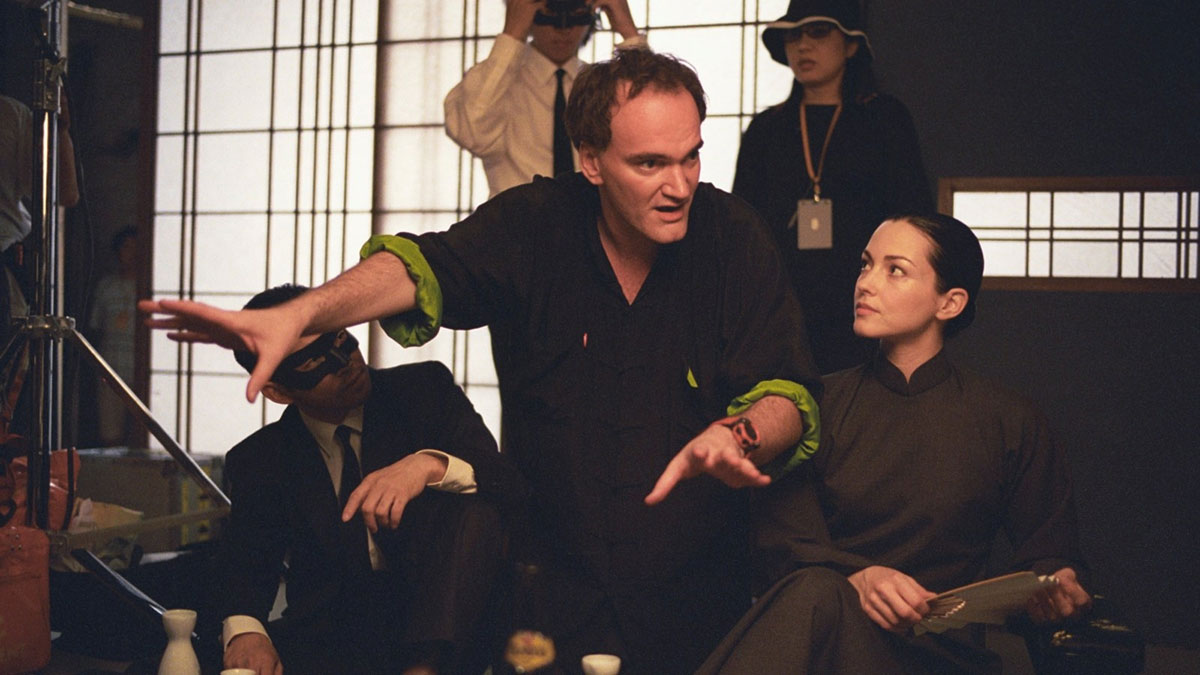
The Whole Bloody Affair: From Myth to Screening

An extended version of Kill Bill running over 4 hours was a myth for years. It was rumored to have been screened at some festivals unofficially. Now, The Whole Bloody Affair, the union of both volumes of Kill Bill, arrives in theaters across Spain in glorious 70mm, with confirmed stops at Mk2 Cine Paz (Madrid) and Palafox (Zaragoza).
Tarantino, a champion of analog exhibition, promises a pure CINEMA experience. And 70mm indeed offers an image three to four times larger than 35mm, but there is a technical detail that marketing leaves out: The Whole Bloody Affair stems from the 2K DI of 2003. The 70mm here is not the source; it's the packaging.
With Oppenheimer, Nolan projected light through an image born and finished photochemically. With Kill Bill, you’re watching light pass through an image that was shot on film, processed digitally, and then blown up to 70mm. A copy of a copy.
Richardson's original Super 35 negatives still exist, and a new 4K scan was technically possible. But redoing everything from scratch in 4K would have meant more time and more money. Tarantino chose the most pragmatic path: the original 2K DI + Weta Digital for 4K visual effects and a transfer to 70mm.
The Verdict from the Projection Booth
Does this mean the 70mm print of Kill Bill is a scam? Not at all. The experience of a movie theater remains irreplaceable. The flicker of the mechanical shutter, the beam of light from the xenon lamp, and the spectacular DTS sound of a cinema are things no television can replicate. Furthermore, the new cut is better: the anime sequence without cuts, unreleased scenes not shown in 2003, the Crazy 88 massacre in full color, and no cliffhanger from Vol. 1. Ultimately, a film closer to what Tarantino always had in mind.
With this new 70mm print, Tarantino has given Kill Bill the best sound in its history, but he has also asked a digital file from 2003 to fill a physical canvas for which it was not designed. Like repainting The Starry Night at the scale of Guernica.
The result is beautiful, excessive, and imperfect. Exactly like the film itself.
Sources
- 70mm Projection
- Kill Bill: The 70mm Engagements — in70mm.com
- Super 35 · Technique
- A Perfectionist's Guide to Super 35 — American Cinematographer, Dec. 1997
- Poster
- Kill Bill: The Whole Bloody Affair (2006) — IMPAwards